Serenity Soul Stones
Calcite on Goethite Epimorphs After Selenite – Santa Eulalia, Mexico – 0.61 lbs
Calcite on Goethite Epimorphs After Selenite – Santa Eulalia, Mexico – 0.61 lbs
Couldn't load pickup availability
Collector Reviews ⭐⭐⭐⭐⭐
Collector Reviews ⭐⭐⭐⭐⭐
★★★★★ 4,382+ Verified Collector Reviews
Google • Whatnot • Facebook
5.0 Average Rating
Read all verified reviews →
Buy with Complete Confidence
Buy with Complete Confidence
Every specimen is photographed individually.
You'll receive the exact mineral shown.
✔ 4,382+ verified collector reviews
✔ 18,700+ collector orders
✔ Family-owned Colorado business
✔ Professionally packaged for fragile minerals
✔ Exact specimen guarantee — you'll receive the mineral shown
⭐ Learn why thousands of collectors trust Serenity Soul Stones →
Shipping & Packaging
Shipping & Packaging
Every specimen benefits from packaging methods refined over 18,700+ collector shipments.
Every specimen is carefully inspected before shipping.
Each mineral is individually wrapped using multiple layers of protective materials and securely packed to minimize movement during transit.
✔ Professionally packaged for fragile mineral specimens
✔ Exact specimen shown is the one you'll receive
✔ Fast shipping from our Colorado warehouse
✔ Tracking provided on every order
✔ Secure packaging designed for collectors
If your specimen arrives damaged in transit, contact us right away and we'll work with you to make it right.
📦Learn more about our Shipping Policy→
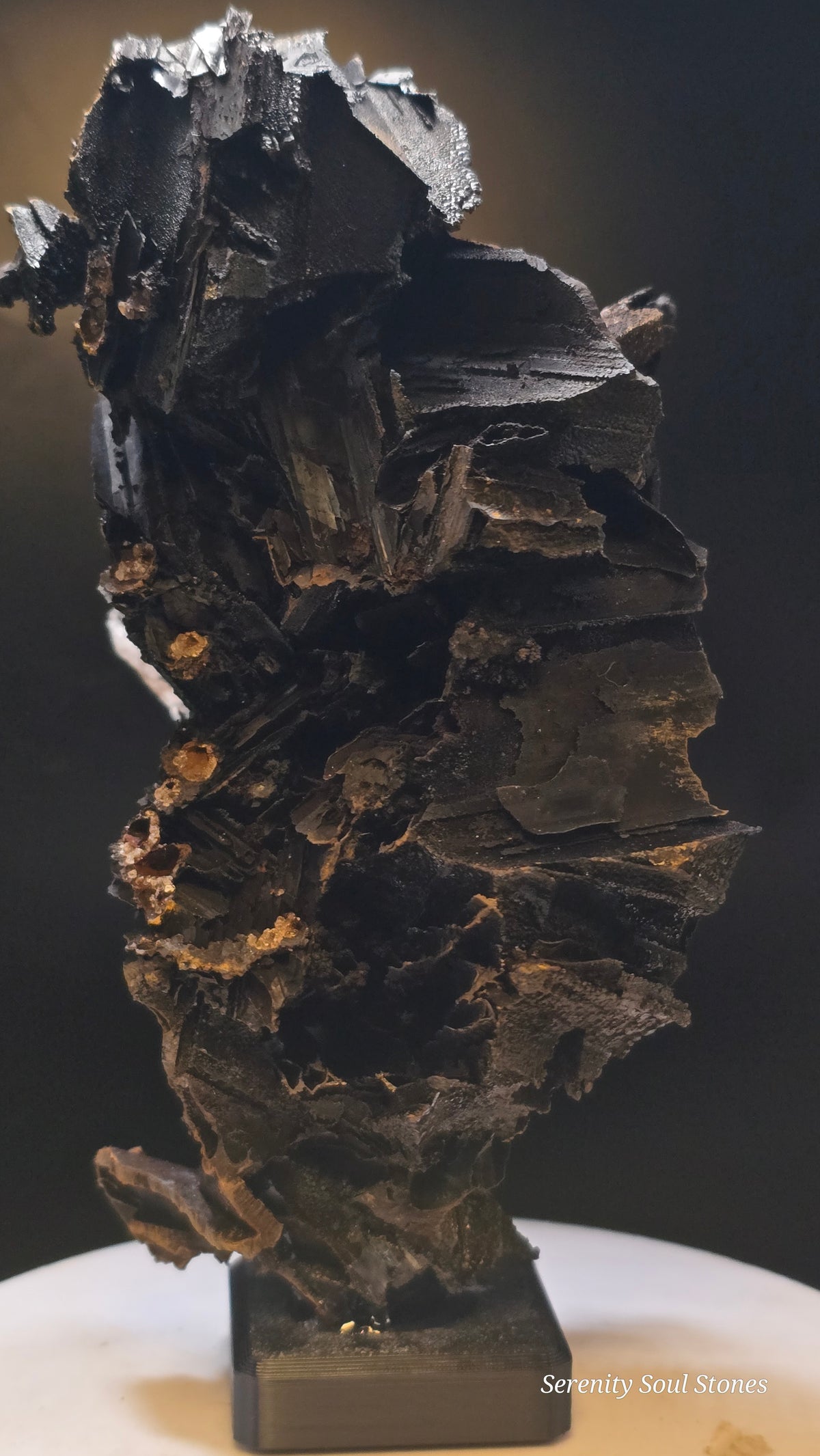
A dramatic mineralogical pseudomorph-style formation from Santa Eulalia, Chihuahua, Mexico, featuring sparkling calcite crystals growing across dark goethite epimorphs after selenite. Mounted vertically for display, this architectural specimen measures approximately 6 inches tall and presents a striking contrast between bright crystalline calcite and nearly black iron-oxide forms.
The specimen is dominated by overlapping blades, hollow shells, and angular structures created when goethite coated earlier selenite crystals. The original selenite provided the underlying shape, while subsequent alteration or removal left the dark goethite preserving its bladed geometry. Numerous broken or open sections expose the shell-like construction and reveal golden-brown interiors along selected edges.
Colorless-to-pale champagne calcite occupies several areas along one side of the formation. These crystals form sparkling aggregates with sharp reflective faces, adding a luminous focal point against the dark brown and black goethite. Smaller calcite growths and mineralized pockets appear between the larger blades, rewarding close inspection from multiple angles.
The reverse emphasizes the goethite architecture, displaying stacked plates, curved remnants, recessed cavities, and rugged iron-rich textures. Its tall sculptural profile and complex replacement history make this an especially interesting specimen for collectors of Mexican minerals, epimorphs, pseudomorph-related formations, calcite, and iron oxides.
Specifications
Primary Minerals: Calcite and goethite
Formation: Calcite on goethite epimorphs preserving earlier selenite crystal forms
Locality: Santa Eulalia Mining District, Chihuahua, Mexico
Weight: 0.61 lbs, approximately 277 grams
Dimensions: Approximately 2.5 × 6 × 3 inches
Color: Black, dark chocolate brown, rusty brown, golden ochre, colorless, pale champagne, and icy white
Goethite Habit: Overlapping bladed, hollow, shell-like, and angular epimorph structures
Calcite Habit: Transparent-to-translucent crystalline aggregates with bright reflective faces
Luster: Vitreous across the calcite; submetallic, earthy, and locally reflective across the goethite
Transparency: Transparent-to-translucent calcite over opaque goethite
Chemical Formulas: CaCO₃ for calcite; FeO(OH) for goethite
Display: Mounted upright on a fitted black display base
Condition: Natural specimen with inherent contacts, open epimorph shells, incomplete blades, broken edges, cavities, surface deposits, mineral staining, and irregularities associated with replacement, extraction, and preparation
Exact specimen shown
About Goethite Epimorphs After Selenite
An epimorph forms when one mineral coats an earlier crystal and preserves its exterior shape. If the original mineral later dissolves or alters, a hollow or partially hollow shell may remain. Here, the bladed forms are identified as goethite epimorphs after selenite, recording the geometry of the earlier selenite growth.
Later calcite crystallization added transparent and champagne-toned sparkle across portions of the darker formation. This sequence of mineral growth gives the specimen both its unusual architecture and its pronounced contrast.
Goethite is an iron oxyhydroxide, while calcite is calcium carbonate. Both can occur within the oxidized, mineral-rich environments of the historic Santa Eulalia mining district.
Collector Notes
This specimen features:
- Natural calcite and goethite from Santa Eulalia, Mexico
- Goethite epimorphs preserving earlier selenite forms
- Hollow and partially open bladed structures
- Layered, sculptural iron-oxide architecture
- Sparkling colorless-to-champagne calcite
- Dramatic light-versus-dark mineral contrast
- Golden-brown exposed edges and interiors
- Numerous cavities and recessed mineralized pockets
- Approximately 6-inch upright profile
- Mounted, ready-to-display presentation
- Strong visual interest from every side
- Exact specimen pictured
Professionally packaged and shipped from Colorado.
You will receive the exact specimen shown.
Thank you for supporting our family-owned small business.
Share